
Sea Turtle
Sea turtles are ancient marine reptiles that migrate widely, breathe air, and return to beaches to nest.
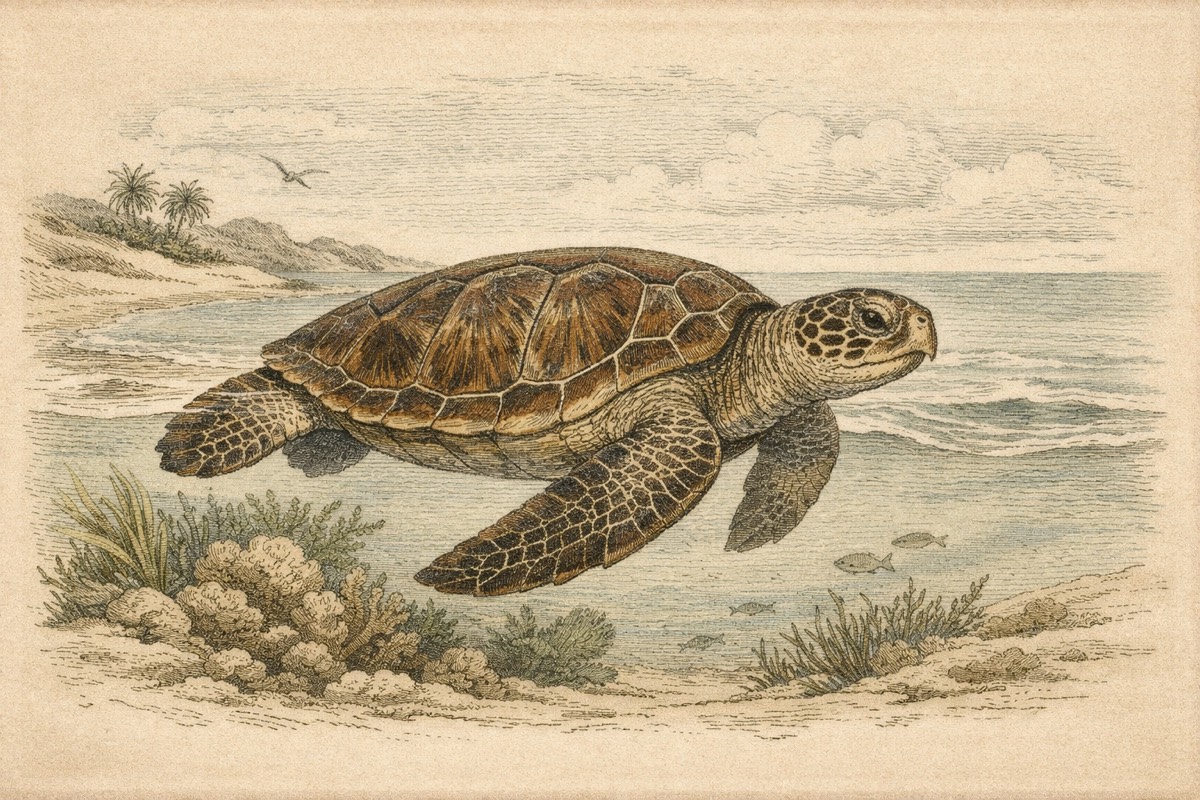
Sea Turtles live in open ocean, coastal waters, reefs, and nesting beaches. Sea turtles occur in tropical, subtropical, and some temperate oceans worldwide. Flippers and a streamlined shell make sea turtles effective long-distance swimmers. Sea turtles help maintain seagrass beds, reef balance, and nutrient flow between sea and shore.
Sea turtles are mostly solitary except during breeding gatherings. They are active day and night depending on species, age, and habitat. Fishing gear, plastic pollution, beach disturbance, poaching, and climate change are major threats.
Quick Facts
| Scientific name | Superfamily Chelonioidea |
|---|---|
| Animal type | Marine reptile |
| Diet | Varies by species from herbivore to carnivore |
| Habitat | Open ocean, coastal waters, reefs, and nesting beaches |
| Lifespan | Often several decades |
| Weight | About 35 to more than 600 kg depending on species |
| Length or height | Roughly 70 cm to more than 2 meters depending on species |
| Top speed | Usually moderate swimmers, with bursts when needed |
| Conservation status | Most species are threatened |
Field Notes
60 notes and observations for quick reference.
- Scientifically, sea turtles are placed under Superfamily Chelonioidea.
- They belong to the marine reptile group.
- Their diet can be described as varies by species from herbivore to carnivore.
- They are most closely associated with open ocean, coastal waters, reefs, and nesting beaches.
- Life span is often several decades.
- Adults commonly weigh about 35 to more than 600 kg depending on species.
- Typical size is roughly 70 cm to more than 2 meters depending on species.
- Movement is usually usually moderate swimmers, with bursts when needed.
- Their conservation status is currently listed as most species are threatened.
- Sea turtles occur in tropical, subtropical, and some temperate oceans worldwide.
- Sea turtles are mostly solitary except during breeding gatherings.
- They are active day and night depending on species, age, and habitat.
- Sea turtles do not form permanent social groups.
- Young sea turtles are called hatchlings.
- Females come ashore to lay eggs in nests dug into sandy beaches.
- Strong flippers power long migrations through the ocean.
- Feeding style depends on species, from grazing seagrass to crushing shellfish to eating jellyfish.
- Some species eat jellyfish, crustaceans, mollusks, or seagrass depending on their niche.
- Vision, magnetic sensitivity, and chemical cues all help sea turtles navigate.
- Sea turtles are generally quiet and rely more on timing and movement than on complex social signals.
- A hard shell, strong swimming, and open-water mobility provide protection.
- Flippers and a streamlined shell make sea turtles effective long-distance swimmers.
- Sea Turtles depend on habitat quality, food supply, and safe breeding conditions to keep populations stable.
- Climate, food supply, and safe habitat all shape how successfully sea turtles can survive and reproduce.
- Sea turtles help maintain seagrass beds, reef balance, and nutrient flow between sea and shore.
- Fishing gear, plastic pollution, beach disturbance, poaching, and climate change are major threats.
- Warm ocean currents and suitable sandy nesting beaches are especially important.
- Sea turtles cannot pull fully into their shells like many land turtles can.
- The shell shape is flatter and more streamlined than in most freshwater turtles.
- Powerful front flippers provide propulsion, while rear flippers help with steering and digging nests.
- Different species have differently shaped jaws matched to their preferred foods.
- Sea turtles must surface to breathe air even though they spend most of life in water.
- Juveniles of some species spend years drifting in the open ocean.
- Adults may forage on reefs, seagrass meadows, or soft-bottom coasts.
- Nesting beaches need the right sand, slope, and low disturbance.
- Ocean currents strongly influence hatchling dispersal.
- Many females return close to the region where they hatched to lay eggs.
- Sea turtles can migrate between feeding grounds and nesting beaches over huge distances.
- They may rest under ledges, in vegetation, or on the seafloor.
- Hatchlings usually emerge at night and rush toward the brighter horizon over the sea.
- Adults often lead independent lives between breeding seasons.
- Green sea turtles become more herbivorous as they mature.
- Leatherbacks are especially known for feeding on jellyfish.
- Loggerheads use strong jaws to crush hard-shelled prey.
- Diet can shift with age because young turtles often use different habitat from adults.
- Dozens of eggs may be laid in a single nest.
- Incubation temperature can influence the sex of hatchlings in many species.
- Only a small fraction of hatchlings survive to adulthood.
- Sea turtles mature slowly, which makes population recovery difficult.
- Protecting nesting beaches is one of the most visible parts of sea turtle conservation.
- Reducing bycatch in fisheries can greatly improve survival.
- Artificial lights near beaches can confuse hatchlings heading to the sea.
- Warmer sand temperatures caused by climate change may affect nesting success and sex ratios.
- Sea turtles can cross whole ocean basins during their lives.
- Magnetic cues may help them navigate back toward important areas.
- A hatchling begins life with an immediate sprint from sand to surf.
- Different sea turtle species can share the same coastline while using different foods.
- Their life cycle connects beaches, shallow coasts, and open ocean in one species story.
- Some individuals return to the same broad nesting region repeatedly over many years.
- Sea turtles show how strongly marine life can depend on healthy shorelines.
Habitat and Range
Sea Turtles are linked to open ocean, coastal waters, reefs, and nesting beaches. Sea turtles occur in tropical, subtropical, and some temperate oceans worldwide. Juveniles of some species spend years drifting in the open ocean. Adults may forage on reefs, seagrass meadows, or soft-bottom coasts.
Behavior and Lifestyle
Sea turtles are mostly solitary except during breeding gatherings. They are active day and night depending on species, age, and habitat. Many females return close to the region where they hatched to lay eggs. Sea turtles can migrate between feeding grounds and nesting beaches over huge distances.
Diet and Feeding
Their diet is varies by species from herbivore to carnivore. Feeding style depends on species, from grazing seagrass to crushing shellfish to eating jellyfish. Some species eat jellyfish, crustaceans, mollusks, or seagrass depending on their niche. Green sea turtles become more herbivorous as they mature.
Conservation and Adaptations
Flippers and a streamlined shell make sea turtles effective long-distance swimmers. Fishing gear, plastic pollution, beach disturbance, poaching, and climate change are major threats. Protecting nesting beaches is one of the most visible parts of sea turtle conservation. Sea turtles help maintain seagrass beds, reef balance, and nutrient flow between sea and shore.