
Octopus
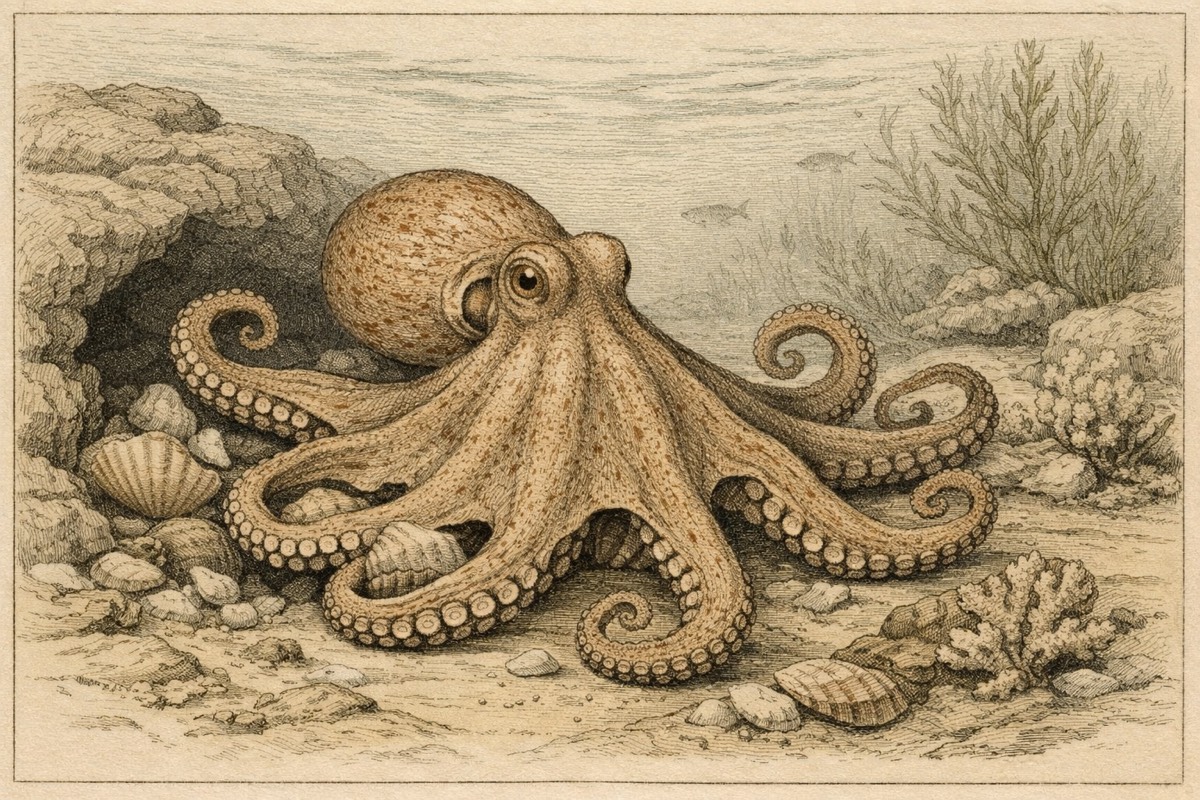
Octopuses are intelligent marine invertebrates famous for flexible bodies, camouflage, problem-solving, and dexterous arms.
Octopuses live in coastal reefs, seabeds, kelp forests, and deep ocean depending on species. Octopuses live in oceans around the world from shallow coasts to deep water. A soft body and advanced skin control allow octopuses to squeeze in and blend in. Octopuses are active mid-level predators and important prey for larger marine animals.
Most octopuses are solitary. Many species are active at night, though patterns vary. Habitat disturbance, warming seas, and fishing pressure affect some species.
Quick Facts
| Scientific name | Order Octopoda |
|---|---|
| Animal type | Marine invertebrate |
| Diet | Carnivore |
| Habitat | Coastal reefs, seabeds, kelp forests, and deep ocean depending on species |
| Lifespan | Often 1 to 5 years depending on species |
| Weight | From under 1 kg to more than 50 kg depending on species |
| Length or height | Varies widely by species |
| Top speed | Fast jet-propelled bursts over short distances |
| Conservation status | Usually not globally assessed as one group |
Field Notes
60 notes and observations for quick reference.
- Scientifically, octopuses are placed under Order Octopoda.
- They belong to the marine invertebrate group.
- Their diet can be described as carnivore.
- They are most closely associated with coastal reefs, seabeds, kelp forests, and deep ocean depending on species.
- Life span is often 1 to 5 years depending on species.
- Adult weight ranges from under 1 kg to more than 50 kg depending on species.
- Body size varies widely by species.
- Movement is usually fast jet-propelled bursts over short distances.
- Their conservation status is currently listed as usually not globally assessed as one group.
- Octopuses live in oceans around the world from shallow coasts to deep water.
- Most octopuses are solitary.
- Many species are active at night, though patterns vary.
- Octopuses do not form stable social groups.
- Young octopuses are often called hatchlings or larvae depending on development stage.
- Many octopus species reproduce once, and females guard eggs intensively before dying.
- They crawl with their arms, glide, or use jet propulsion for quick escape.
- Octopuses hunt by stalking, pouncing, probing crevices, or ambushing from cover.
- Crabs, shrimp, mollusks, and small fish are common prey.
- Touch and chemical sensing through the arms combine with strong vision.
- Color change, posture, texture change, and movement all carry information.
- Camouflage, ink release, hiding, and rapid escape are major defenses.
- A soft body and advanced skin control allow octopuses to squeeze in and blend in.
- Octopuses depend on habitat quality, food supply, and safe breeding conditions to keep populations stable.
- Climate, food supply, and safe habitat all shape how successfully octopuses can survive and reproduce.
- Octopuses are active mid-level predators and important prey for larger marine animals.
- Habitat disturbance, warming seas, and fishing pressure affect some species.
- Different octopus species live in warm reefs, cool coasts, and deep, dark seas.
- An octopus has eight arms lined with suckers.
- The body has no internal shell, which makes it extremely flexible.
- Large eyes help with detecting movement and contrast underwater.
- Skin can change both color and texture in many species.
- A hard beak sits at the center where the arms meet.
- Crevices, rocky dens, and coral structures provide shelter and ambush points.
- Many octopuses collect shells or stones near the den entrance.
- Species living in open sand must rely more on burial or camouflage.
- Deep-sea octopuses face very different pressures from reef-dwelling species.
- Octopuses are widely known for solving simple problems and exploring new objects.
- They often use the arms independently while examining the environment.
- A resting octopus may still shift color slightly with mood or surroundings.
- Some species can imitate the appearance of other animals or drifting debris.
- An octopus usually prefers escape and concealment over open confrontation.
- Suckers help hold struggling prey securely.
- Some octopuses drill into shells or pry them open.
- Poisonous saliva can help subdue certain prey items.
- A patient ambush may save energy compared with active chasing.
- Eggs are often attached in strings or clusters inside a protected den.
- A mother may stop feeding while guarding eggs.
- Many species have short lives and grow quickly.
- Young stages may drift in the plankton before settling to the seabed.
- Because octopuses grow quickly, some populations respond differently to fishing pressure than long-lived fish do.
- Healthy reef and seafloor habitats are important for shelter and egg protection.
- Warming and acidifying seas may change prey availability and habitat quality.
- Octopuses are useful indicators of how clever predators use small-scale marine habitat.
- A very small gap is enough for many octopuses to squeeze through if the beak fits.
- Their camouflage can change in seconds.
- Each arm contains a great deal of independent nerve control.
- Octopuses sometimes carry objects that may later be used as shelter.
- They are among the best-known invertebrates for problem-solving behavior.
- An ink cloud can distract predators and buy time for escape.
- The same animal can look smooth, spiky, pale, or dark depending on context.
Habitat and Range
Octopuses are linked to coastal reefs, seabeds, kelp forests, and deep ocean depending on species. Octopuses live in oceans around the world from shallow coasts to deep water. Crevices, rocky dens, and coral structures provide shelter and ambush points. Many octopuses collect shells or stones near the den entrance.
Behavior and Lifestyle
Most octopuses are solitary. Many species are active at night, though patterns vary. Octopuses are widely known for solving simple problems and exploring new objects. They often use the arms independently while examining the environment.
Diet and Feeding
Their diet is carnivore. Octopuses hunt by stalking, pouncing, probing crevices, or ambushing from cover. Crabs, shrimp, mollusks, and small fish are common prey. Suckers help hold struggling prey securely.
Conservation and Adaptations
A soft body and advanced skin control allow octopuses to squeeze in and blend in. Habitat disturbance, warming seas, and fishing pressure affect some species. Because octopuses grow quickly, some populations respond differently to fishing pressure than long-lived fish do. Octopuses are active mid-level predators and important prey for larger marine animals.