
Blue Whale
Blue whales are the largest animals known to have lived, feeding mainly on tiny krill in the open ocean.
Blue Whales live in open ocean. Blue whales occur in major oceans around the world, often with seasonal migration patterns. Baleen plates allow blue whales to filter vast numbers of tiny prey from seawater. Blue whales connect ocean food webs and move nutrients through feeding and waste.
They are usually seen alone or in pairs rather than large stable groups. Blue whales remain active across day and night, with behavior linked to feeding depth and prey movement. Ship strikes, entanglement, noise, climate change, and past whaling pressure affect recovery.
Quick Facts
| Scientific name | Balaenoptera musculus |
|---|---|
| Animal type | Marine mammal |
| Diet | Carnivore |
| Habitat | Open ocean |
| Lifespan | Often 70 to 90 years |
| Weight | Up to about 150 tonnes or more |
| Length or height | Up to about 30 meters long |
| Top speed | Up to 50 km/h in bursts, usually slower |
| Conservation status | Endangered |
Field Notes
60 notes and observations for quick reference.
- Scientifically, blue whales are placed under Balaenoptera musculus.
- They belong to the marine mammal group.
- Their diet can be described as carnivore.
- They are most closely associated with open ocean.
- Life span is often 70 to 90 years.
- Adults commonly weigh up to about 150 tonnes or more.
- Body size can reach up to about 30 meters long.
- Top speed can reach up to 50 km/h in bursts, usually slower.
- Their conservation status is currently listed as endangered.
- Blue whales occur in major oceans around the world, often with seasonal migration patterns.
- They are usually seen alone or in pairs rather than large stable groups.
- Blue whales remain active across day and night, with behavior linked to feeding depth and prey movement.
- Blue whales do not form long-term social groups like dolphin pods.
- Young blue whales are called calves.
- A single calf is usually born after a pregnancy of about a year.
- A streamlined body and immense tail flukes power long-distance travel.
- Blue whales use lunge feeding, engulfing huge volumes of water rich in krill.
- Krill make up most of the diet.
- Hearing is very important for communication across long distances underwater.
- Low-frequency calls can travel far through the ocean.
- Their enormous size is the main defense against most predators.
- Baleen plates allow blue whales to filter vast numbers of tiny prey from seawater.
- Blue Whales depend on habitat quality, food supply, and safe breeding conditions to keep populations stable.
- Climate, food supply, and safe habitat all shape how successfully blue whales can survive and reproduce.
- Blue whales connect ocean food webs and move nutrients through feeding and waste.
- Ship strikes, entanglement, noise, climate change, and past whaling pressure affect recovery.
- They follow productive ocean zones where krill gather in large numbers.
- The blue whale is the largest animal known from Earth's history.
- Its heart is enormous because it must support a giant body.
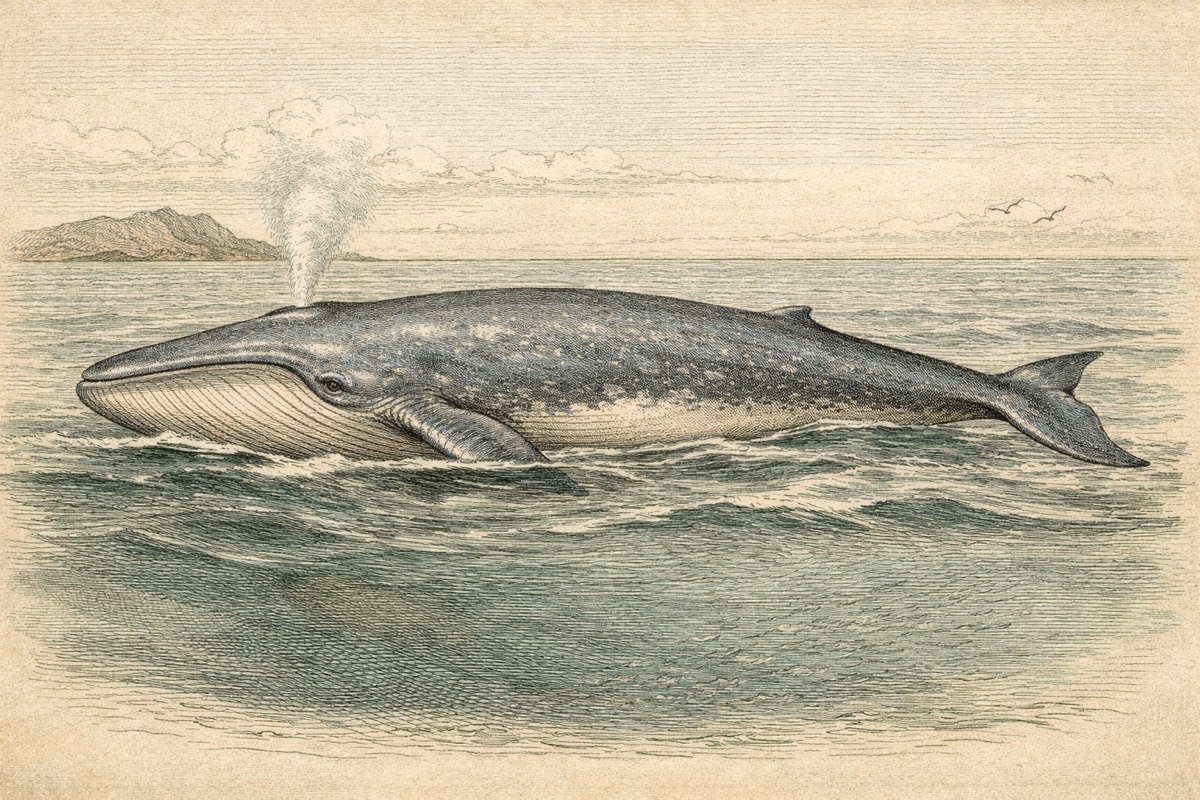
- The body is long, streamlined, and colored with blue-gray mottling.
- A small dorsal fin sits far back on the body.
- Baleen plates hang from the upper jaw instead of teeth.
- Blue whales spend most of their lives in open ocean habitat.
- They often move toward productive feeding grounds during certain seasons.
- Polar and temperate waters can be especially important for summer feeding.
- Migration routes may connect rich feeding areas with warmer breeding waters.
- Blue whales regularly dive and surface in repeating travel and feeding patterns.
- They can feed at different depths depending on where krill concentrate.
- Pairs are often a mother and calf or temporarily associated adults.
- Their long migrations require efficient energy use.
- Surface blows are tall and visible because of the force of exhalation.
- Despite their huge size, blue whales eat tiny crustaceans rather than large fish.
- A feeding lunge stretches throat pleats to take in a massive mouthful of water.
- After closing the mouth, the tongue helps force water out through the baleen.
- Dense krill swarms are essential because such a large body needs huge energy intake.
- Calves drink rich milk and grow rapidly in early life.
- A mother-calf pair must coordinate breathing and travel at the surface.
- Slow reproduction means population recovery from heavy losses takes time.
- Long life spans mean individual whales may experience many changes in ocean conditions.
- Commercial whaling once reduced blue whale numbers drastically.
- International protection ended industrial hunting, but recovery is still incomplete.
- Mapping migration routes helps reduce collision risk with ships.
- Healthy krill populations are essential for blue whale conservation.
- A blue whale's tongue alone can weigh as much as a large land animal.
- Their low calls are among the deepest sounds made by animals.
- Even the largest whale depends on some of the smallest ocean prey.
- From a distance, the blow can be the first sign that a blue whale is nearby.
- Blue whales show how productive ocean currents can support giant life.
- The scale of their body makes ordinary swimming movements look slow and effortless.
- No dinosaur is currently known to have exceeded the blue whale in overall mass.
Habitat and Range
Blue Whales are linked to open ocean. Blue whales occur in major oceans around the world, often with seasonal migration patterns. Blue whales spend most of their lives in open ocean habitat. They often move toward productive feeding grounds during certain seasons.
Behavior and Lifestyle
They are usually seen alone or in pairs rather than large stable groups. Blue whales remain active across day and night, with behavior linked to feeding depth and prey movement. Blue whales regularly dive and surface in repeating travel and feeding patterns. They can feed at different depths depending on where krill concentrate.
Diet and Feeding
Their diet is carnivore. Blue whales use lunge feeding, engulfing huge volumes of water rich in krill. Krill make up most of the diet. Despite their huge size, blue whales eat tiny crustaceans rather than large fish.
Conservation and Adaptations
Baleen plates allow blue whales to filter vast numbers of tiny prey from seawater. Ship strikes, entanglement, noise, climate change, and past whaling pressure affect recovery. Commercial whaling once reduced blue whale numbers drastically. Blue whales connect ocean food webs and move nutrients through feeding and waste.