
Flamingo
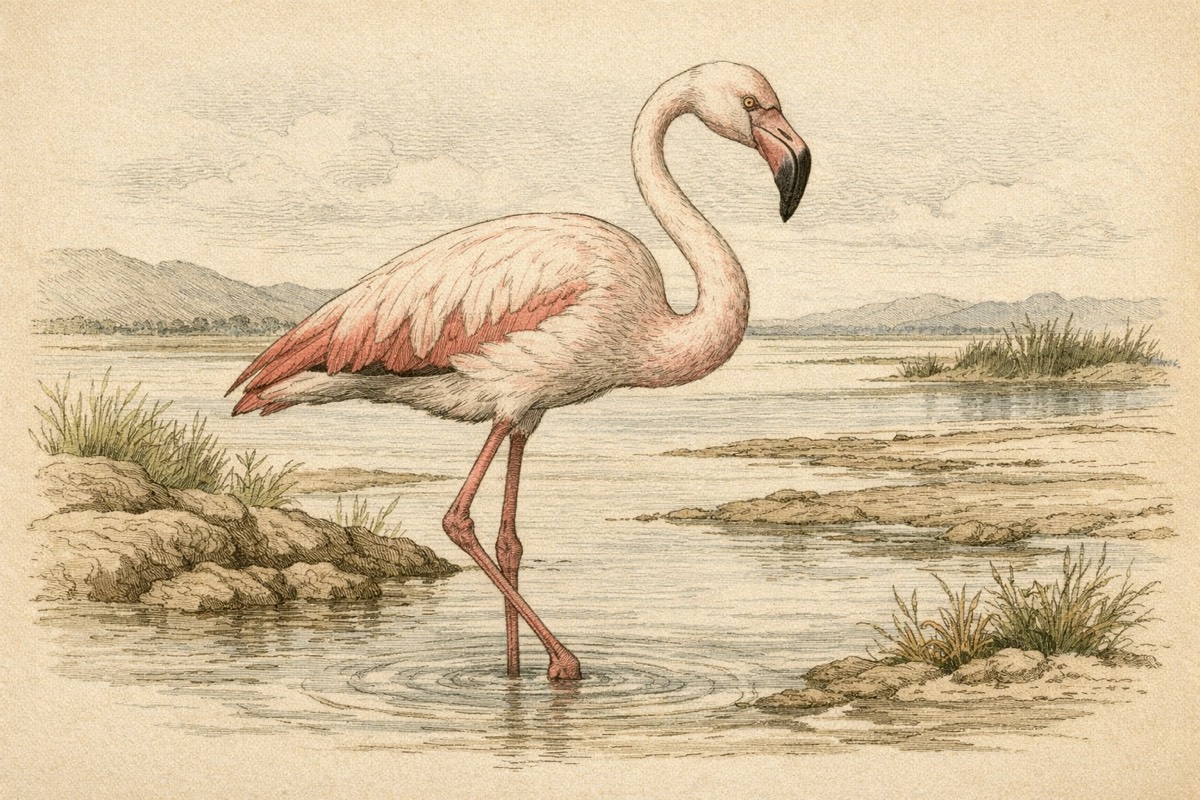
Flamingos are long-legged wetland birds known for filter-feeding bills, social colonies, and pink plumage from diet.
Flamingos live in shallow saline lakes, lagoons, mudflats, and wetlands. Flamingos live in parts of Africa, southern Europe, Asia, and the Americas depending on species. Their downturned bill is highly specialized for filter feeding. Flamingos help cycle nutrients in wetlands and reflect the productivity of shallow aquatic systems.
They are highly social birds that often live and breed in large colonies. Flamingos can feed and move during both day and night. Wetland loss, pollution, water diversion, and disturbance at breeding sites are important threats.
Quick Facts
| Scientific name | Family Phoenicopteridae |
|---|---|
| Animal type | Bird |
| Diet | Omnivore, mostly filter feeding on small aquatic organisms |
| Habitat | Shallow saline lakes, lagoons, mudflats, and wetlands |
| Lifespan | Often 20 to 30 years and sometimes more |
| Weight | About 2 to 4 kg depending on species |
| Length or height | Roughly 80 cm to 1.5 meters tall |
| Top speed | Strong, direct flight over long distances |
| Conservation status | Generally Least Concern, depending on species |
Field Notes
60 notes and observations for quick reference.
- Scientifically, flamingos are placed under Family Phoenicopteridae.
- They belong to the bird group.
- Their diet can be described as omnivore, mostly filter feeding on small aquatic organisms.
- They are most closely associated with shallow saline lakes, lagoons, mudflats, and wetlands.
- Life span is often 20 to 30 years and sometimes more.
- Adults commonly weigh about 2 to 4 kg depending on species.
- Typical size is roughly 80 cm to 1.5 meters tall.
- Movement is usually strong, direct flight over long distances.
- Their conservation status is currently listed as generally least concern, depending on species.
- Flamingos live in parts of Africa, southern Europe, Asia, and the Americas depending on species.
- They are highly social birds that often live and breed in large colonies.
- Flamingos can feed and move during both day and night.
- A group of flamingos is often called a flamboyance.
- Young flamingos are called chicks.
- Flamingos usually lay a single egg on a cone-shaped mud nest.
- Long legs allow wading, and broad wings enable long-distance flight.
- They filter food from shallow water using specialized bills and tongue movement.
- Algae, tiny crustaceans, larvae, and other small aquatic organisms are common foods.
- Vision helps with flock behavior and feeding site choice, while touch inside the bill helps filter food.
- Calls and synchronized display behavior help flamingos coordinate social life and breeding.
- Safety in numbers and use of open wetland habitat help reduce predation risk.
- Their downturned bill is highly specialized for filter feeding.
- Flamingos depend on habitat quality, food supply, and safe breeding conditions to keep populations stable.
- Climate, food supply, and safe habitat all shape how successfully flamingos can survive and reproduce.
- Flamingos help cycle nutrients in wetlands and reflect the productivity of shallow aquatic systems.
- Wetland loss, pollution, water diversion, and disturbance at breeding sites are important threats.
- Warm or seasonally dry wetlands with shallow feeding areas suit flamingos well.
- Pink plumage comes largely from pigments in the food they eat.
- Long legs keep the body above shallow water while feeding.
- The neck is long and flexible for reaching into the water.
- The bill works like a filter rather than a simple pecking beak.
- Webbed feet help support movement in soft mud.
- Salty or alkaline lakes can support huge flamingo flocks because few other animals use the same food source as efficiently.
- Shallow depth is important because feeding depends on bill position in the water.
- Breeding sites are often chosen where water or mud offers some protection from ground predators.
- Wetland conditions can change quickly with rainfall and evaporation.
- Flamingos often move and feed in coordinated groups.
- Mass courtship displays help synchronize breeding in large colonies.
- Parents feed chicks with a nutrient-rich crop secretion in early life.
- Standing on one leg may help conserve body heat, though several explanations have been suggested.
- Colony life gives flamingos many opportunities for visual and vocal interaction.
- The tongue pumps water through filtering structures inside the bill.
- Food choice can influence how bright the plumage becomes.
- Different flamingo species focus on different sizes of prey or particles.
- Wind and water level changes can alter where feeding is best within a wetland.
- Chicks hatch with straighter bills that later develop the adult shape.
- Young flamingos are gray or white rather than pink.
- Large nursery groups may form as chicks grow.
- Breeding success can vary greatly between years depending on water and food conditions.
- Protecting entire wetland systems is more useful than protecting one small shoreline alone.
- Water pollution can quickly affect the invertebrates and algae flamingos depend on.
- Disturbance during nesting can reduce breeding success in large colonies.
- Flamingos remind people that salty, shallow wetlands are valuable wildlife habitats, not empty wastelands.
- Few birds are as instantly recognizable by color and posture as flamingos.
- Huge colonies can turn a shoreline into a moving field of pink.
- The same bird may spend hours feeding with its head upside down in the water.
- Long flights connect wetlands that may be far apart.
- Young birds must grow into both the bill shape and the color that adults are known for.
- Flamingos depend on productive microscopic life more than on large visible prey.
- Their appearance may look delicate, but it is matched to very specific wetland conditions.
Habitat and Range
Flamingos are linked to shallow saline lakes, lagoons, mudflats, and wetlands. Flamingos live in parts of Africa, southern Europe, Asia, and the Americas depending on species. Salty or alkaline lakes can support huge flamingo flocks because few other animals use the same food source as efficiently. Shallow depth is important because feeding depends on bill position in the water.
Behavior and Lifestyle
They are highly social birds that often live and breed in large colonies. Flamingos can feed and move during both day and night. Flamingos often move and feed in coordinated groups. Mass courtship displays help synchronize breeding in large colonies.
Diet and Feeding
Their diet is omnivore, mostly filter feeding on small aquatic organisms. They filter food from shallow water using specialized bills and tongue movement. Algae, tiny crustaceans, larvae, and other small aquatic organisms are common foods. The tongue pumps water through filtering structures inside the bill.
Conservation and Adaptations
Their downturned bill is highly specialized for filter feeding. Wetland loss, pollution, water diversion, and disturbance at breeding sites are important threats. Protecting entire wetland systems is more useful than protecting one small shoreline alone. Flamingos help cycle nutrients in wetlands and reflect the productivity of shallow aquatic systems.