
Komodo Dragon
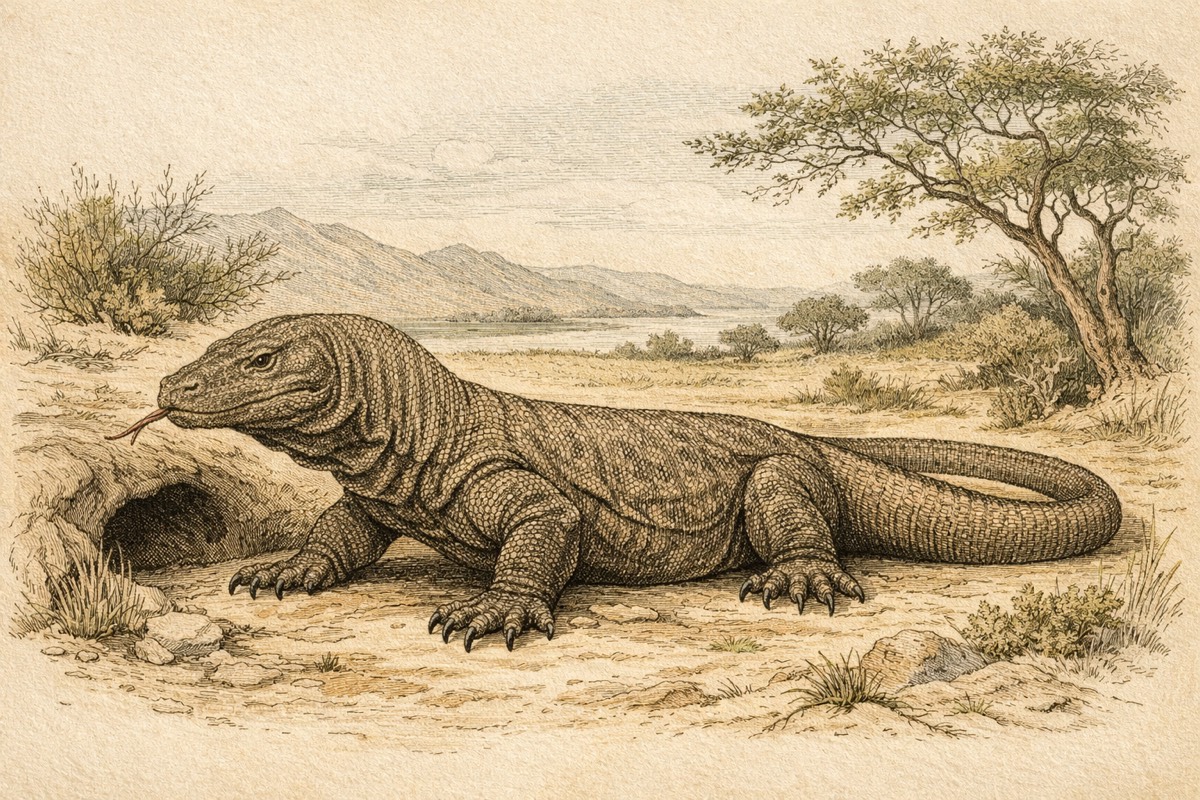
Komodo dragons are the largest living lizards, combining sharp senses, strong jaws, and island-adapted predatory behavior.
Komodo Dragons live in dry forests, savannas, and scrub on indonesian islands. Komodo dragons live naturally on a small number of Indonesian islands. Their size and efficient island predatory behavior allow them to dominate local food webs. Komodo dragons are top predators and major scavengers in their island ecosystems.
They are mostly solitary but may gather at carcasses or breeding sites. Adults are mainly active by day, especially in the morning and late afternoon. Small range size, climate change, habitat pressure, and human disturbance are major threats.
Quick Facts
| Scientific name | Varanus komodoensis |
|---|---|
| Animal type | Reptile |
| Diet | Carnivore |
| Habitat | Dry forests, savannas, and scrub on Indonesian islands |
| Lifespan | Often around 30 years |
| Weight | About 70 to more than 90 kg |
| Length or height | Up to about 3 meters long |
| Top speed | Up to 20 km/h in short bursts |
| Conservation status | Endangered |
Field Notes
60 notes and observations for quick reference.
- Scientifically, komodo dragons are placed under Varanus komodoensis.
- They belong to the reptile group.
- Their diet can be described as carnivore.
- They are most closely associated with dry forests, savannas, and scrub on indonesian islands.
- Life span is often around 30 years.
- Adults commonly weigh about 70 to more than 90 kg.
- Body size can reach up to about 3 meters long.
- Top speed can reach up to 20 km/h in short bursts.
- Their conservation status is currently listed as endangered.
- Komodo dragons live naturally on a small number of Indonesian islands.
- They are mostly solitary but may gather at carcasses or breeding sites.
- Adults are mainly active by day, especially in the morning and late afternoon.
- Komodo dragons do not form stable social groups.
- Young komodo dragons are called hatchlings.
- Females lay eggs in nests, sometimes using mounds or dug burrows.
- They walk with a strong, sprawling gait and can sprint briefly when needed.
- Komodo dragons use ambush, tracking, and scavenging as part of their feeding strategy.
- Deer, pigs, smaller reptiles, carrion, and other available animals are eaten.
- Chemical sensing through the tongue helps detect scent over long distances.
- Body posture, scent, and direct interaction matter more than vocal communication.
- Large size, sharp teeth, claws, and muscular bodies make adults formidable.
- Their size and efficient island predatory behavior allow them to dominate local food webs.
- Komodo Dragons depend on habitat quality, food supply, and safe breeding conditions to keep populations stable.
- Climate, food supply, and safe habitat all shape how successfully komodo dragons can survive and reproduce.
- Komodo dragons are top predators and major scavengers in their island ecosystems.
- Small range size, climate change, habitat pressure, and human disturbance are major threats.
- Hot, dry island climates with seasonal rainfall suit them well.
- Komodo dragons are the heaviest lizards living today.
- Their forked tongues sample chemical particles from the air.
- Strong claws help them dig, climb when young, and hold prey.
- Teeth are sharp, curved, and well suited to cutting flesh.
- The tail is muscular and can aid balance and defense.
- Dry hillsides, open woodland, and savanna edges provide hunting and basking opportunities.
- Burrows can help dragons escape midday heat.
- Island ecosystems limit where the species can expand naturally.
- Access to prey and suitable nesting areas shapes local distribution.
- Young komodo dragons spend more time in trees than adults to avoid cannibalism.
- Adults may wait quietly near trails or water before ambushing prey.
- Large carcasses can attract several dragons at once, creating dominance interactions.
- Basking is important because body temperature controls activity.
- Even large adults often conserve energy by moving slowly until opportunity appears.
- Carrion is an important food source and reduces hunting effort.
- Large adults can tackle prey far bigger than small monitor lizards usually take.
- Once feeding begins, sharp teeth help tear chunks from a carcass.
- Young dragons focus more on insects, eggs, and small vertebrates.
- Eggs develop in warm nesting sites protected from flooding and predators.
- Hatchlings emerge highly vulnerable and must find cover quickly.
- Slow growth to giant adult size takes years.
- Low numbers and restricted range make every successful breeding season valuable.
- Because the species occurs on only a few islands, local habitat change can matter a great deal.
- Sea-level rise and climate change may shrink suitable coastal habitat.
- Protected areas are especially important for maintaining prey and nesting sites.
- Komodo dragon conservation also highlights the uniqueness of island ecosystems.
- A large komodo dragon can dominate a carcass simply through size and confidence.
- Young dragons survive partly by using different habitat from adults.
- The species became world-famous because it resembles a prehistoric giant lizard.
- Chemical tracking helps dragons locate food they cannot yet see.
- Island life shaped the komodo dragon into an unusually large reptile predator.
- Adults may look slow, but their short bursts can be sudden and forceful.
- Few reptiles combine top-predator status and island specialization as clearly as the komodo dragon.
Habitat and Range
Komodo Dragons are linked to dry forests, savannas, and scrub on indonesian islands. Komodo dragons live naturally on a small number of Indonesian islands. Dry hillsides, open woodland, and savanna edges provide hunting and basking opportunities. Burrows can help dragons escape midday heat.
Behavior and Lifestyle
They are mostly solitary but may gather at carcasses or breeding sites. Adults are mainly active by day, especially in the morning and late afternoon. Young komodo dragons spend more time in trees than adults to avoid cannibalism. Adults may wait quietly near trails or water before ambushing prey.
Diet and Feeding
Their diet is carnivore. Komodo dragons use ambush, tracking, and scavenging as part of their feeding strategy. Deer, pigs, smaller reptiles, carrion, and other available animals are eaten. Carrion is an important food source and reduces hunting effort.
Conservation and Adaptations
Their size and efficient island predatory behavior allow them to dominate local food webs. Small range size, climate change, habitat pressure, and human disturbance are major threats. Because the species occurs on only a few islands, local habitat change can matter a great deal. Komodo dragons are top predators and major scavengers in their island ecosystems.