
Chameleon
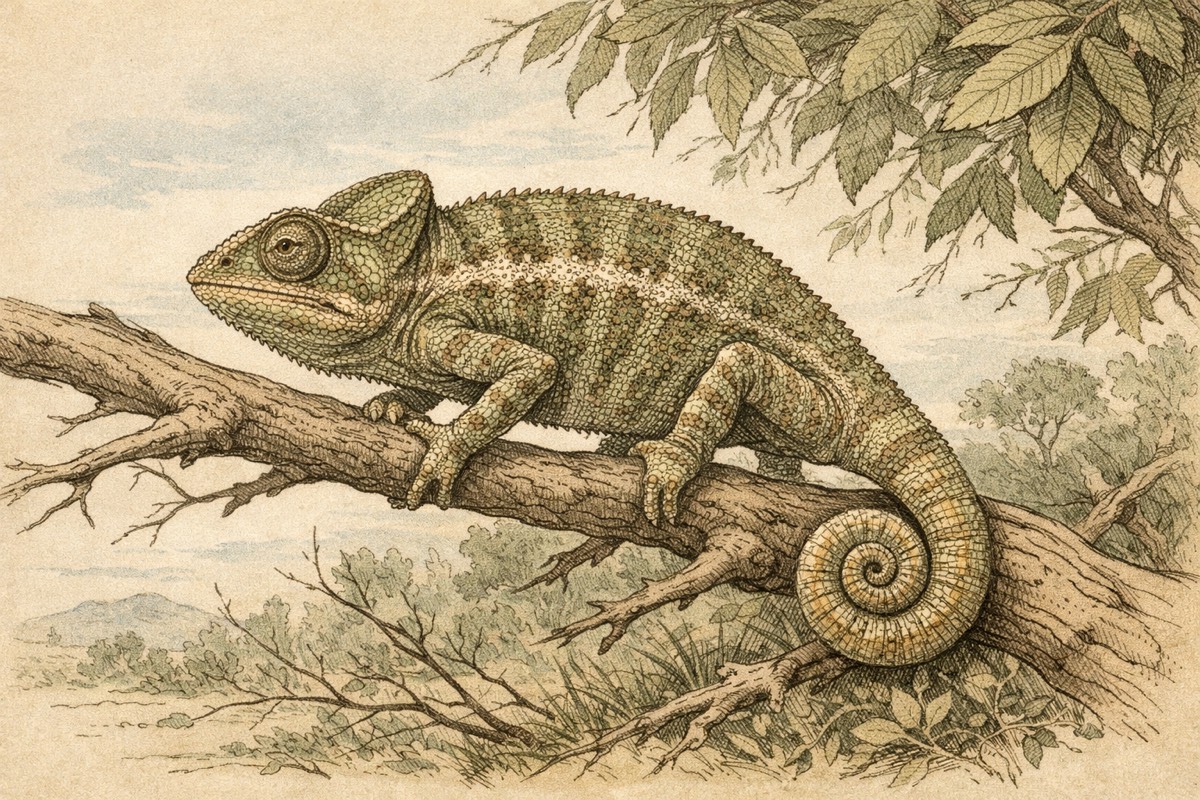
Chameleons are tree-climbing reptiles known for color change, independently moving eyes, and rapid projectile tongues.
Chameleons live in forests, shrublands, and dry woodland depending on species. Chameleons are most diverse in Africa and Madagascar, with some species in parts of Europe and Asia. A projectile tongue and grasping body design make chameleons efficient branch hunters. Chameleons help control insect populations in their habitats.
Most chameleons are solitary and territorial. They are mainly active by day. Habitat loss, illegal collection, and climate pressure threaten many species.
Quick Facts
| Scientific name | Family Chamaeleonidae |
|---|---|
| Animal type | Reptile |
| Diet | Carnivore |
| Habitat | Forests, shrublands, and dry woodland depending on species |
| Lifespan | Often 2 to 10 years depending on species |
| Weight | Usually light-bodied, varying by species |
| Length or height | From a few centimeters to over 60 cm depending on species |
| Top speed | Slow deliberate climbing, with very fast tongue strikes |
| Conservation status | Varies by species |
Field Notes
60 notes and observations for quick reference.
- Scientifically, chameleons are placed under Family Chamaeleonidae.
- They belong to the reptile group.
- Their diet can be described as carnivore.
- They are most closely associated with forests, shrublands, and dry woodland depending on species.
- Life span is often 2 to 10 years depending on species.
- Adults commonly weigh usually light-bodied, varying by species.
- Body size ranges from a few centimeters to over 60 cm depending on species.
- Movement is usually slow deliberate climbing, with very fast tongue strikes.
- Their conservation status is currently listed as varies by species.
- Chameleons are most diverse in Africa and Madagascar, with some species in parts of Europe and Asia.
- Most chameleons are solitary and territorial.
- They are mainly active by day.
- Chameleons do not form stable social groups.
- Young chameleons are hatchlings or juveniles.
- Many chameleons lay eggs, while some species give birth to live young.
- They move slowly and carefully through vegetation using grasping feet and prehensile tails.
- Most species wait or creep close, then launch a fast tongue to catch prey.
- Insects are the main food, though large species may eat small vertebrates.
- Vision is especially important, and the eyes can move independently.
- Color change, posture, and body inflation can signal mood or territorial intent.
- Camouflage, stillness, warning colors, and arboreal escape are major defenses.
- A projectile tongue and grasping body design make chameleons efficient branch hunters.
- Chameleons depend on habitat quality, food supply, and safe breeding conditions to keep populations stable.
- Climate, food supply, and safe habitat all shape how successfully chameleons can survive and reproduce.
- Chameleons help control insect populations in their habitats.
- Habitat loss, illegal collection, and climate pressure threaten many species.
- Warm environments with suitable vegetation and perches are essential.
- The eyes can focus in different directions at the same time.
- Zygodactyl feet help grip narrow branches.
- Many species have a prehensile tail used like an extra anchor.
- Color change reflects mood, temperature, light, and communication as well as camouflage.
- The tongue can extend far beyond body length in some species.
- Branches and shrubs are essential because many chameleons are specialized climbers.
- Leaf cover helps reduce exposure to predators and sun.
- Some species live in humid forests, while others survive in drier scrub.
- Small-range species can be highly vulnerable when habitat patches disappear.
- Chameleons often sway gently while moving, which may mimic leaves in the wind.
- Slow movement helps them stay unnoticed by both prey and predators.
- Males may defend territories visually rather than through prolonged fighting.
- Basking and shade use help control body temperature throughout the day.
- Independent eye movement allows wide scanning without revealing much body motion.
- Tongue projection is powered by specialized elastic structures.
- Prey capture depends on timing and depth judgment.
- A sitting-and-waiting strategy saves energy compared with constant chasing.
- Larger species can occasionally take birds or other small vertebrates.
- Egg-laying species hide eggs in soil or loose substrate.
- Incubation times can be long and vary with species and temperature.
- Young chameleons are independent very soon after hatching or birth.
- Rapid growth can be important before dry seasons or cool periods.
- Madagascar's unique chameleon diversity makes forest conservation especially important.
- Illegal pet trade has placed pressure on some rare species.
- Because many species have small ranges, local habitat damage can be critical.
- Protecting shrub and forest structure helps conserve far more than just one reptile group.
- A chameleon may scan in one direction with one eye and another direction with the other eye.
- Their famous color change is often more about communication and physiology than simple background matching.
- The grip of the feet and tail makes climbing look slow but very secure.
- Some species are tiny enough to live in very small habitat patches.
- A tongue strike happens much faster than the rest of chameleon movement suggests.
- Branch life shaped nearly every part of the chameleon body plan.
- Few reptiles are as closely associated with visual control and patience as chameleons.
Habitat and Range
Chameleons are linked to forests, shrublands, and dry woodland depending on species. Chameleons are most diverse in Africa and Madagascar, with some species in parts of Europe and Asia. Branches and shrubs are essential because many chameleons are specialized climbers. Leaf cover helps reduce exposure to predators and sun.
Behavior and Lifestyle
Most chameleons are solitary and territorial. They are mainly active by day. Chameleons often sway gently while moving, which may mimic leaves in the wind. Slow movement helps them stay unnoticed by both prey and predators.
Diet and Feeding
Their diet is carnivore. Most species wait or creep close, then launch a fast tongue to catch prey. Insects are the main food, though large species may eat small vertebrates. Tongue projection is powered by specialized elastic structures.
Conservation and Adaptations
A projectile tongue and grasping body design make chameleons efficient branch hunters. Habitat loss, illegal collection, and climate pressure threaten many species. Madagascar's unique chameleon diversity makes forest conservation especially important. Chameleons help control insect populations in their habitats.