
Lion
Lions are social big cats best known for life in prides, deep roars, and powerful cooperative hunting.
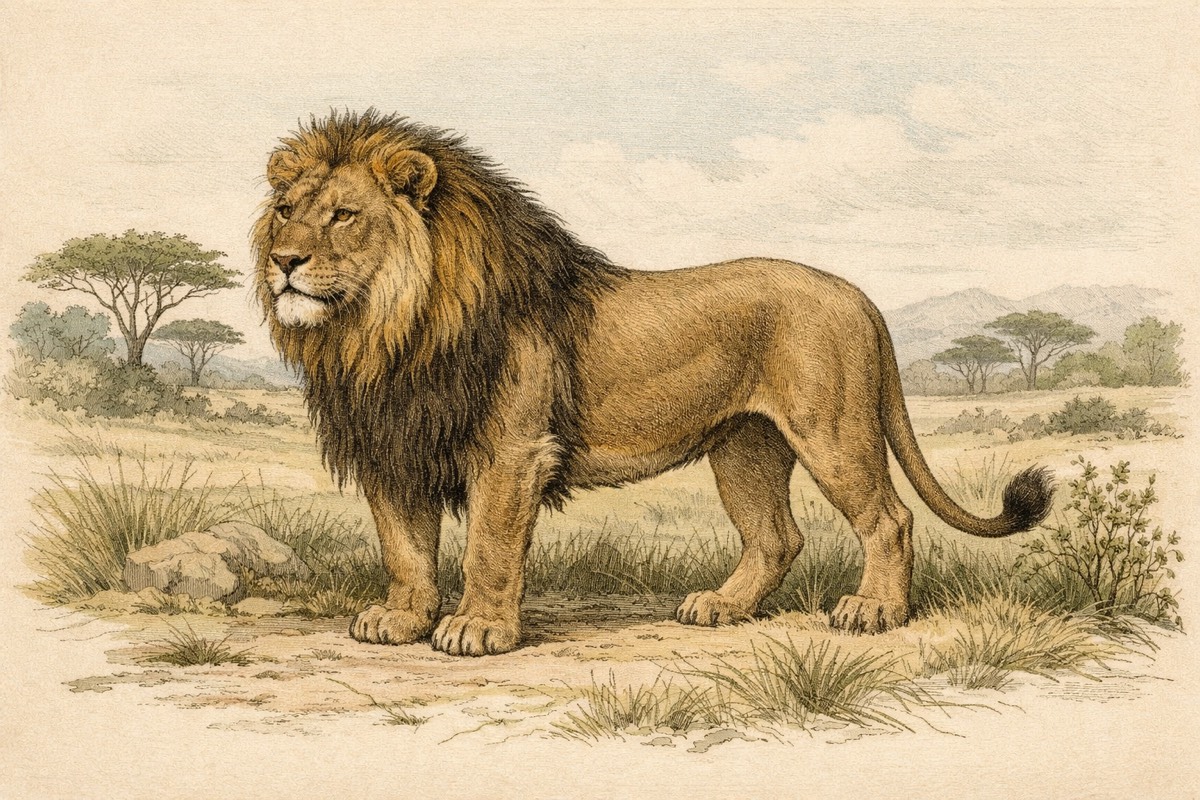
Lions live in grasslands, savannas, scrublands, and open woodlands. Most wild lions live in sub-Saharan Africa, while a small Asiatic population survives in India's Gir Forest. A muscular body, retractable claws, and social hunting behavior are among their key adaptations. As apex predators, lions influence prey behavior and help maintain ecological balance.
Lions are the most social big cats and often live in family groups called prides. They are most active at night and during the cooler hours of dawn and dusk. Habitat loss, conflict with livestock owners, and declining prey populations are major threats.
Quick Facts
| Scientific name | Panthera leo |
|---|---|
| Animal type | Mammal |
| Diet | Carnivore |
| Habitat | Grasslands, savannas, scrublands, and open woodlands |
| Lifespan | About 10 to 14 years in the wild |
| Weight | Around 120 to 250 kg |
| Length or height | About 1.2 meters tall at the shoulder |
| Top speed | Up to 80 km/h in short bursts |
| Conservation status | Vulnerable |
Field Notes
60 notes and observations for quick reference.
- Scientifically, lions are placed under Panthera leo.
- They belong to the mammal group.
- Their diet can be described as carnivore.
- They are most closely associated with grasslands, savannas, scrublands, and open woodlands.
- Life span is about 10 to 14 years in the wild.
- Adults commonly weigh around 120 to 250 kg.
- Typical size is about 1.2 meters tall at the shoulder.
- Top speed can reach up to 80 km/h in short bursts.
- Their conservation status is currently listed as vulnerable.
- Most wild lions live in sub-Saharan Africa, while a small Asiatic population survives in India's Gir Forest.
- Lions are the most social big cats and often live in family groups called prides.
- They are most active at night and during the cooler hours of dawn and dusk.
- A group of lions is usually called a pride.
- Young lions are called cubs.
- Females usually give birth to one to four cubs after a gestation period of a little over three months.
- They depend on stealth, stalking, and explosive speed rather than long-distance chasing.
- Lionesses often cooperate during hunts, especially when targeting large hoofed mammals.
- Typical prey includes zebras, wildebeest, buffalo, antelope, and other medium to large herbivores.
- Strong night vision, sharp hearing, and sensitive whiskers help lions hunt in dim light.
- Roaring, scent marking, facial expressions, and body posture all help lions communicate.
- Size, teamwork, powerful jaws, and heavy forelimbs help lions defend kills and territory.
- A muscular body, retractable claws, and social hunting behavior are among their key adaptations.
- Lions depend on habitat quality, food supply, and safe breeding conditions to keep populations stable.
- Climate, food supply, and safe habitat all shape how successfully lions can survive and reproduce.
- As apex predators, lions influence prey behavior and help maintain ecological balance.
- Habitat loss, conflict with livestock owners, and declining prey populations are major threats.
- They do best in warm, open habitats with cover for stalking and enough prey.
- Male lions usually grow manes that make them look larger and help protect the neck during fights.
- Mane color can vary from light blond to dark brown and often deepens with age.
- A lion's tongue has rough papillae that help strip meat from bones.
- Their forelegs are especially powerful because they need to pull down large prey.
- Lions have padded paws that let them move quietly during the final stage of a hunt.
- Lions prefer habitats where grass or shrubs provide cover for ambush hunting.
- They avoid dense rainforests because stalking and group movement are harder there.
- Water sources attract both prey and predators, so lion territories often include rivers or seasonal pools.
- Territory size changes depending on prey density, habitat quality, and competition from neighboring prides.
- Lions spend many hours resting each day to conserve energy between hunts.
- Prides often groom one another, which reinforces social bonds.
- Adult males defend access to females and territory from rival coalitions.
- Roaring helps lions advertise territory and locate other pride members over long distances.
- Lions can scavenge from carcasses when the opportunity is easier than hunting.
- Large prey can feed many pride members at once, which makes teamwork worthwhile.
- Lions usually try to get close to prey before sprinting because chases are expensive in terms of energy.
- They often begin feeding at the abdomen of a carcass because it is easier to open.
- During hard times, lions may take smaller prey or steal food from other predators.
- Cubs are born spotted, and faint markings can remain visible as they grow.
- Lion cubs are hidden in cover during their earliest weeks of life.
- Young males often leave their birth pride when they mature.
- Female relatives commonly help protect and nurse cubs within the same pride.
- Protected reserves help lions most when they also preserve prey species and movement corridors.
- Conflict reduction programs can lower retaliatory killing near livestock areas.
- Monitoring lion populations is important because numbers can decline even when the species remains widespread.
- Healthy lion populations are often signs of large, functioning savanna ecosystems.
- A lion's roar can be heard several kilometers away under the right conditions.
- Lions are one of the few cat species in which adults regularly cooperate in groups.
- Different pride members may take on different roles during a hunt.
- Males sometimes rest together in coalitions long before they take over a pride.
- Lion cubs learn social rules as much from observation as from play.
- Not every lion hunt succeeds, especially when prey spots the pride early.
- Shade, wind direction, and moonlight can all influence hunting behavior.
Habitat and Range
Lions are linked to grasslands, savannas, scrublands, and open woodlands. Most wild lions live in sub-Saharan Africa, while a small Asiatic population survives in India's Gir Forest. Lions prefer habitats where grass or shrubs provide cover for ambush hunting. They avoid dense rainforests because stalking and group movement are harder there.
Behavior and Lifestyle
Lions are the most social big cats and often live in family groups called prides. They are most active at night and during the cooler hours of dawn and dusk. Lions spend many hours resting each day to conserve energy between hunts. Prides often groom one another, which reinforces social bonds.
Diet and Feeding
Their diet is carnivore. Lionesses often cooperate during hunts, especially when targeting large hoofed mammals. Typical prey includes zebras, wildebeest, buffalo, antelope, and other medium to large herbivores. Large prey can feed many pride members at once, which makes teamwork worthwhile.
Conservation and Adaptations
A muscular body, retractable claws, and social hunting behavior are among their key adaptations. Habitat loss, conflict with livestock owners, and declining prey populations are major threats. Protected reserves help lions most when they also preserve prey species and movement corridors. As apex predators, lions influence prey behavior and help maintain ecological balance.