
Tiger
Tigers are the largest wild cats and are famous for striped coats, solitary hunting, and strong swimming ability.
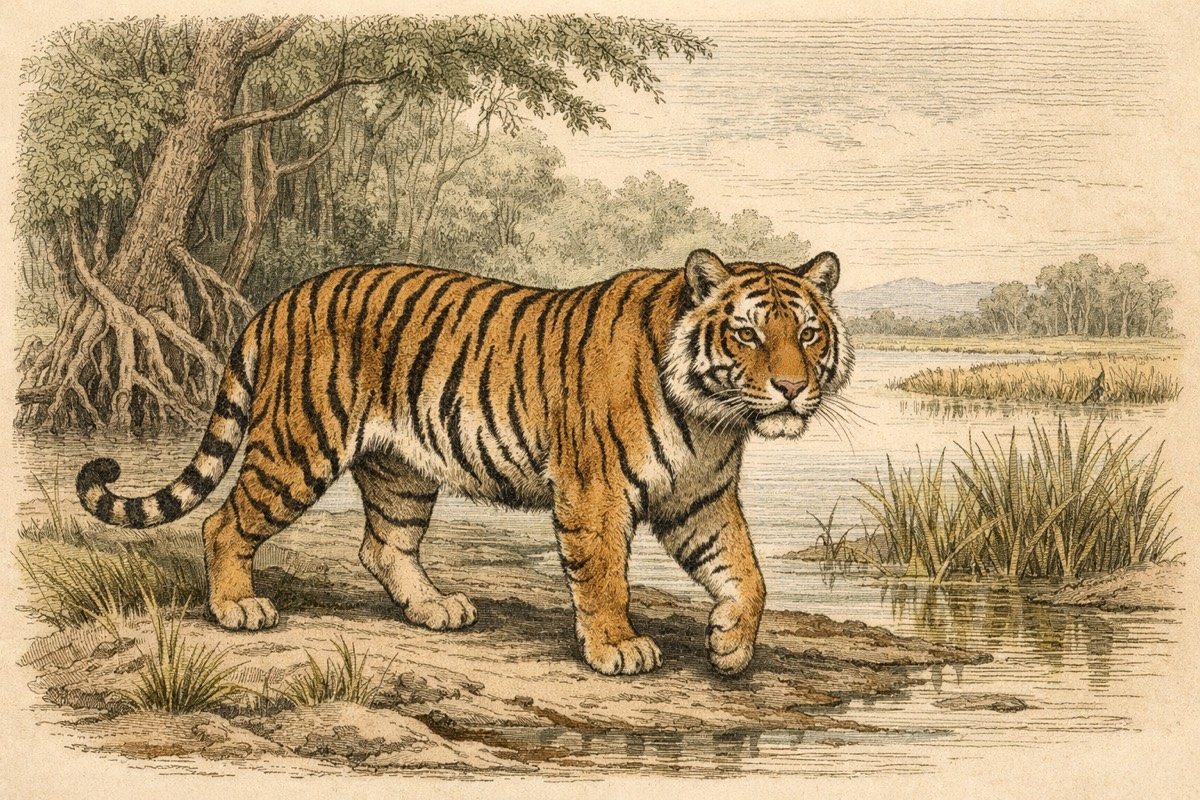
Tigers live in forests, mangroves, grasslands, and wetlands. Wild tigers survive in parts of South Asia, Southeast Asia, and the Russian Far East. Their striped coat breaks up the body outline in tall grass and forest shadows. Tigers are apex predators that help regulate prey populations in Asian ecosystems.
Tigers are mostly solitary and usually meet only to mate, raise cubs, or contest territory. They are often crepuscular and nocturnal, though activity can shift with prey and human pressure. Poaching, habitat fragmentation, and shrinking prey bases are major threats.
Quick Facts
| Scientific name | Panthera tigris |
|---|---|
| Animal type | Mammal |
| Diet | Carnivore |
| Habitat | Forests, mangroves, grasslands, and wetlands |
| Lifespan | About 10 to 15 years in the wild |
| Weight | Roughly 90 to 300 kg depending on subspecies and sex |
| Length or height | Up to about 3.3 meters long including the tail |
| Top speed | Up to 65 km/h in short bursts |
| Conservation status | Endangered |
Field Notes
60 notes and observations for quick reference.
- Scientifically, tigers are placed under Panthera tigris.
- They belong to the mammal group.
- Their diet can be described as carnivore.
- They are most closely associated with forests, mangroves, grasslands, and wetlands.
- Life span is about 10 to 15 years in the wild.
- Adults commonly weigh roughly 90 to 300 kg depending on subspecies and sex.
- Body size can reach up to about 3.3 meters long including the tail.
- Top speed can reach up to 65 km/h in short bursts.
- Their conservation status is currently listed as endangered.
- Wild tigers survive in parts of South Asia, Southeast Asia, and the Russian Far East.
- Tigers are mostly solitary and usually meet only to mate, raise cubs, or contest territory.
- They are often crepuscular and nocturnal, though activity can shift with prey and human pressure.
- There is no strong social group structure because tigers usually live alone.
- Young tigers are called cubs.
- Females usually raise litters of two to four cubs and care for them alone.
- Tigers combine silent stalking with strong leaps, short sprints, and confident swimming.
- They usually ambush prey from cover and aim for the neck or throat.
- Deer, wild boar, gaur, and other medium to large mammals form much of the diet.
- Excellent hearing, sharp vision, and sensitive whiskers help tigers judge distance and movement.
- Scent marks, scratch marks, vocal calls, and body language help tigers communicate.
- A powerful bite, heavy forelimbs, claws, and camouflage make tigers formidable predators.
- Their striped coat breaks up the body outline in tall grass and forest shadows.
- Tigers depend on habitat quality, food supply, and safe breeding conditions to keep populations stable.
- Climate, food supply, and safe habitat all shape how successfully tigers can survive and reproduce.
- Tigers are apex predators that help regulate prey populations in Asian ecosystems.
- Poaching, habitat fragmentation, and shrinking prey bases are major threats.
- Tigers tolerate a range of climates as long as cover, water, and prey are available.
- Every tiger has a unique stripe pattern, much like a fingerprint.
- Tiger stripes are present on the skin as well as the fur.
- Their large paws help distribute weight when moving across soft ground.
- A tiger's tail helps with balance during quick turns and leaps.
- Strong shoulder muscles give tigers the power to drag heavy prey.
- Dense vegetation is especially important because tigers depend on cover for ambush hunting.
- Mangrove tigers face muddy ground, tidal water, and shifting channels.
- Tigers often stay close to freshwater because they drink often and enjoy bathing.
- Large territories are necessary where prey is scattered or habitat is fragmented.
- Tigers regularly patrol their territories and refresh scent marks.
- They often rest in cool shade or water during the hottest part of the day.
- Adult males usually hold territories that overlap with those of several females.
- A mother tiger teaches hunting skills to cubs over many months.
- Tigers can be patient hunters and may wait quietly before striking.
- Tigers usually prefer ungulates because a large kill can feed them for days.
- They sometimes cover unfinished carcasses with leaves or grass.
- A tiger may abandon a hunt if wind changes and reveals its position.
- Although they are powerful, tigers do not succeed in every ambush attempt.
- Tiger cubs are born blind and fully dependent on their mother.
- Young tigers stay with their mother for well over a year.
- Dispersing juveniles must find open territory to survive as adults.
- Mortality is highest during the earliest life stages and during dispersal.
- Protected habitat blocks are most effective when they stay connected by wildlife corridors.
- Anti-poaching work matters for both tigers and the prey species they depend on.
- Camera traps are widely used to identify individual tigers by stripe patterns.
- Tiger conservation can help protect entire forest ecosystems, not just one species.
- Tigers are among the few big cats that genuinely enjoy swimming.
- Some tigers travel long distances through forest and river systems.
- The white tiger is not a separate species but a rare color variation in captivity and history.
- Roars are only one part of tiger communication; low grunts and scent marks matter too.
- A tiger's hearing is strong enough to detect subtle sounds made by prey.
- Many tiger subspecies once ranged far more widely than they do today.
- Even a well-camouflaged tiger can be betrayed by a warning call from prey animals.
Habitat and Range
Tigers are linked to forests, mangroves, grasslands, and wetlands. Wild tigers survive in parts of South Asia, Southeast Asia, and the Russian Far East. Dense vegetation is especially important because tigers depend on cover for ambush hunting. Mangrove tigers face muddy ground, tidal water, and shifting channels.
Behavior and Lifestyle
Tigers are mostly solitary and usually meet only to mate, raise cubs, or contest territory. They are often crepuscular and nocturnal, though activity can shift with prey and human pressure. Tigers regularly patrol their territories and refresh scent marks. They often rest in cool shade or water during the hottest part of the day.
Diet and Feeding
Their diet is carnivore. They usually ambush prey from cover and aim for the neck or throat. Deer, wild boar, gaur, and other medium to large mammals form much of the diet. Tigers usually prefer ungulates because a large kill can feed them for days.
Conservation and Adaptations
Their striped coat breaks up the body outline in tall grass and forest shadows. Poaching, habitat fragmentation, and shrinking prey bases are major threats. Protected habitat blocks are most effective when they stay connected by wildlife corridors. Tigers are apex predators that help regulate prey populations in Asian ecosystems.