
Panda
Giant pandas are forest bears specialized for bamboo feeding, strong climbing, and life in cool mountain habitats.
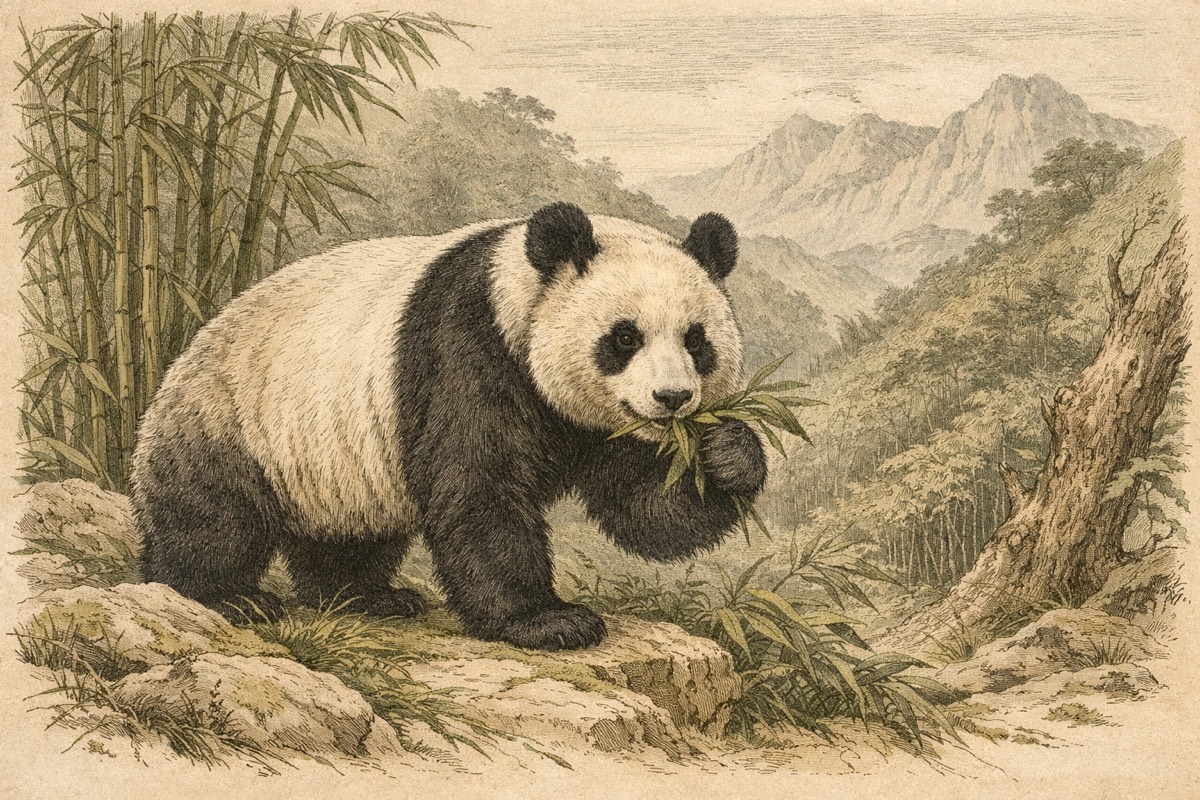
Pandas live in mountain bamboo forests. Wild giant pandas now survive mainly in mountain regions of central China. A thumb-like wrist bone helps pandas grip bamboo stems. Pandas are part of mountain forest food webs and can influence bamboo use and seed dispersal.
Pandas are mostly solitary outside of breeding and maternal care. They feed and rest in repeated cycles throughout the day and night. Habitat fragmentation and limited breeding opportunities remain important concerns.
Quick Facts
| Scientific name | Ailuropoda melanoleuca |
|---|---|
| Animal type | Mammal |
| Diet | Mostly herbivorous, centered on bamboo |
| Habitat | Mountain bamboo forests |
| Lifespan | About 20 years in the wild |
| Weight | Around 70 to 120 kg, with large males heavier |
| Length or height | About 1.2 to 1.9 meters long |
| Top speed | Up to 32 km/h |
| Conservation status | Vulnerable |
Field Notes
60 notes and observations for quick reference.
- Scientifically, pandas are placed under Ailuropoda melanoleuca.
- They belong to the mammal group.
- Their diet can be described as mostly herbivorous, centered on bamboo.
- They are most closely associated with mountain bamboo forests.
- Life span is about 20 years in the wild.
- Adults commonly weigh around 70 to 120 kg, with large males heavier.
- Typical size is about 1.2 to 1.9 meters long.
- Top speed can reach up to 32 km/h.
- Their conservation status is currently listed as vulnerable.
- Wild giant pandas now survive mainly in mountain regions of central China.
- Pandas are mostly solitary outside of breeding and maternal care.
- They feed and rest in repeated cycles throughout the day and night.
- Pandas do not form stable social groups in the wild.
- Young pandas are called cubs.
- Females usually give birth to one tiny cub after a narrow breeding window each year.
- Pandas walk steadily, climb well, and can scramble across steep forest terrain.
- They spend many hours eating because bamboo is bulky and not very energy-rich.
- Pandas do not rely on prey; bamboo shoots, leaves, and stems make up most of the diet.
- Smell is very important for locating mates and marking territory.
- Pandas communicate with scent marks, bleats, chirps, and body posture.
- Strong jaws, large body size, climbing ability, and powerful forelimbs help pandas stay safe.
- A thumb-like wrist bone helps pandas grip bamboo stems.
- Pandas depend on habitat quality, food supply, and safe breeding conditions to keep populations stable.
- Climate, food supply, and safe habitat all shape how successfully pandas can survive and reproduce.
- Pandas are part of mountain forest food webs and can influence bamboo use and seed dispersal.
- Habitat fragmentation and limited breeding opportunities remain important concerns.
- Cool, moist mountain forests with dense bamboo growth suit pandas best.
- The black-and-white coat pattern is one of the most recognizable in the animal world.
- Pandas have broad molars and strong jaw muscles for crushing tough bamboo.
- Their thick fur helps protect them in cool mountain climates.
- The so-called panda thumb is not a real finger but an enlarged wrist bone.
- Pandas have strong shoulders that help them climb and pull bamboo.
- Bamboo forest quality is more important than simple forest area alone.
- Steep slopes and dense understory can still support pandas if bamboo is abundant.
- Seasonal shifts in bamboo growth can influence local movement.
- Connected forest patches matter because isolated pandas have fewer breeding options.
- Pandas often rest between long feeding sessions to save energy.
- They scent-mark tree trunks and rocks to share information with other pandas.
- Mothers are intensely protective of very small cubs.
- Wild pandas generally avoid unnecessary contact with other adults.
- Climbing gives pandas access to safety, resting places, and sometimes food.
- Although pandas belong to the order Carnivora, bamboo dominates their diet.
- They may choose different bamboo parts depending on season and nutrient content.
- Fresh shoots are especially valuable when available.
- Their digestive system is not as specialized as that of true grazing herbivores, so they must eat a lot.
- Panda cubs are born very small compared with the size of the mother.
- Twins can occur, but raising two cubs in the wild is difficult.
- Young pandas stay with their mother for an extended learning period.
- Low reproductive rates make every surviving cub important for population recovery.
- Forest restoration and corridor creation have improved panda prospects in some areas.
- Long-term monitoring helps show how pandas use protected mountain landscapes.
- Panda conservation also protects many other forest species that share the same habitat.
- Climate change may affect bamboo distribution, which could reshape panda habitat over time.
- Pandas often sit upright while holding bamboo in their forepaws.
- They can climb better than many people expect from such a heavy animal.
- A panda's day is built around eating, resting, and moving between feeding patches.
- The panda has become a global symbol of wildlife conservation.
- Pandas can make a range of sounds even though they are usually quiet animals.
- Bamboo may look abundant, but not every stand offers the same nutritional value.
- Even a specialist like the panda depends on a whole mountain ecosystem, not just one plant.
Habitat and Range
Pandas are linked to mountain bamboo forests. Wild giant pandas now survive mainly in mountain regions of central China. Bamboo forest quality is more important than simple forest area alone. Steep slopes and dense understory can still support pandas if bamboo is abundant.
Behavior and Lifestyle
Pandas are mostly solitary outside of breeding and maternal care. They feed and rest in repeated cycles throughout the day and night. Pandas often rest between long feeding sessions to save energy. They scent-mark tree trunks and rocks to share information with other pandas.
Diet and Feeding
Their diet is mostly herbivorous, centered on bamboo. They spend many hours eating because bamboo is bulky and not very energy-rich. Pandas do not rely on prey; bamboo shoots, leaves, and stems make up most of the diet. Although pandas belong to the order Carnivora, bamboo dominates their diet.
Conservation and Adaptations
A thumb-like wrist bone helps pandas grip bamboo stems. Habitat fragmentation and limited breeding opportunities remain important concerns. Forest restoration and corridor creation have improved panda prospects in some areas. Pandas are part of mountain forest food webs and can influence bamboo use and seed dispersal.