
Kangaroo
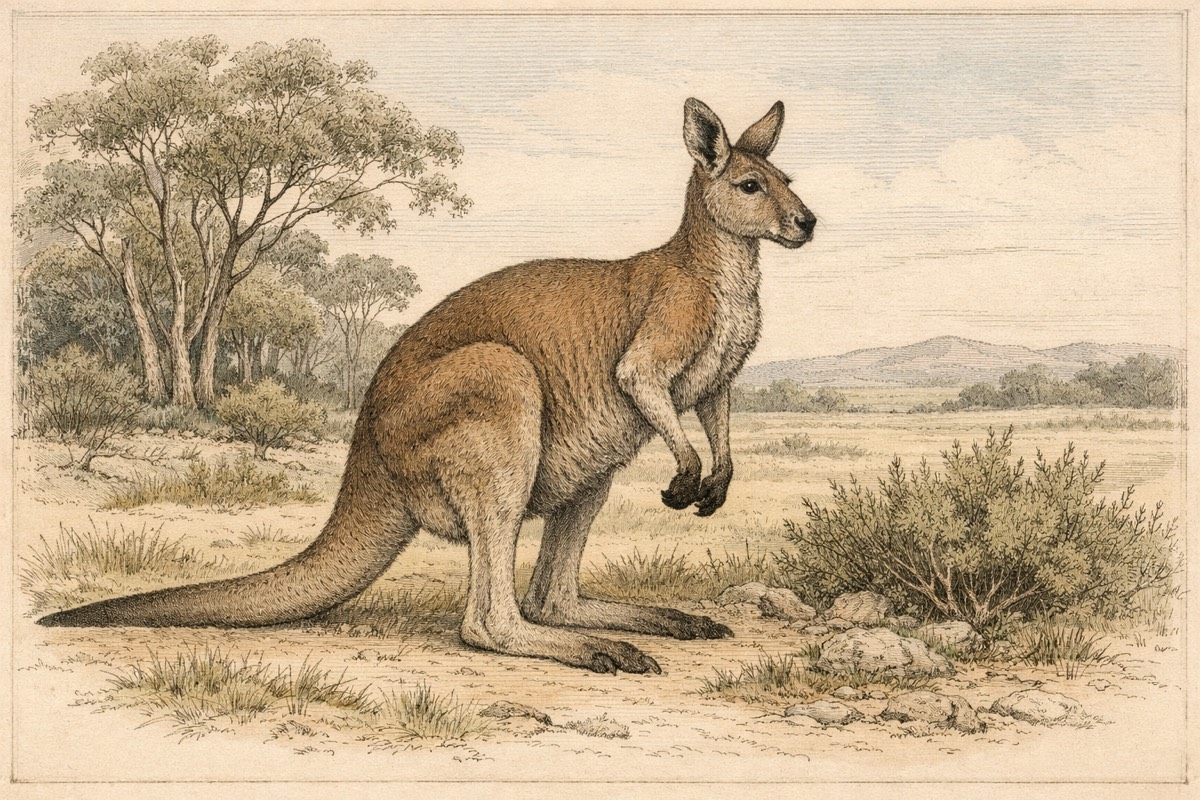
Kangaroos are Australian marsupials built for hopping, grazing, and raising underdeveloped young in a pouch.
Kangaroos live in grasslands, shrublands, woodlands, and semi-arid plains. Kangaroos are native to Australia and nearby regions depending on species. Elastic tendons help kangaroos move efficiently over long distances by hopping. Kangaroos are important grazers in Australian landscapes and prey for large predators in some regions.
Many kangaroos live in loose groups that improve vigilance while feeding. They are often most active in the cooler parts of the day and night. Drought, habitat pressure, road mortality, and fencing can affect local populations.
Quick Facts
| Scientific name | Genus Macropus and related genera |
|---|---|
| Animal type | Mammal |
| Diet | Herbivore |
| Habitat | Grasslands, shrublands, woodlands, and semi-arid plains |
| Lifespan | Often 6 to 12 years in the wild |
| Weight | About 18 to 90 kg depending on species and sex |
| Length or height | Standing height can exceed 1.5 meters in large species |
| Top speed | Up to 70 km/h |
| Conservation status | Usually Least Concern for common species |
Field Notes
60 notes and observations for quick reference.
- Scientifically, kangaroos are placed under Genus Macropus and related genera.
- They belong to the mammal group.
- Their diet can be described as herbivore.
- They are most closely associated with grasslands, shrublands, woodlands, and semi-arid plains.
- Life span is often 6 to 12 years in the wild.
- Adults commonly weigh about 18 to 90 kg depending on species and sex.
- Typical size is standing height can exceed 1.5 meters in large species.
- Top speed can reach up to 70 km/h.
- Their conservation status is currently listed as usually least concern for common species.
- Kangaroos are native to Australia and nearby regions depending on species.
- Many kangaroos live in loose groups that improve vigilance while feeding.
- They are often most active in the cooler parts of the day and night.
- A group of kangaroos is often called a mob.
- Young kangaroos are called joeys.
- Like other marsupials, kangaroos give birth to very underdeveloped young that continue growing in the pouch.
- Powerful hind legs and a strong tail make hopping their signature form of movement.
- Kangaroos graze and browse selectively, often moving between feeding patches as conditions change.
- They do not hunt prey; grasses, leaves, and shoots are the main foods.
- Good hearing and a wide field of view help detect danger in open landscapes.
- Kangaroos communicate through posture, thumping, and soft vocal sounds.
- Powerful kicks, balance from the tail, and quick escape jumps are key defenses.
- Elastic tendons help kangaroos move efficiently over long distances by hopping.
- Kangaroos depend on habitat quality, food supply, and safe breeding conditions to keep populations stable.
- Climate, food supply, and safe habitat all shape how successfully kangaroos can survive and reproduce.
- Kangaroos are important grazers in Australian landscapes and prey for large predators in some regions.
- Drought, habitat pressure, road mortality, and fencing can affect local populations.
- Open habitats with grasses and room to move suit kangaroos well.
- The tail works as a counterbalance when kangaroos hop.
- Large feet and long hind legs are specialized for powerful leaps.
- Kangaroos cannot move backward easily because of the tail and hind-leg structure.
- Their forelimbs are much smaller than their hind limbs.
- The pouch protects the developing joey after birth.
- Open country helps kangaroos detect danger at a distance.
- Some species use woodland edges where there is both cover and grazing.
- Rainfall strongly affects grass growth and therefore kangaroo distribution.
- During dry periods, kangaroos may gather near better feeding areas.
- Mobs allow several animals to watch for predators while others feed.
- Male kangaroos may box with their forelimbs during disputes.
- Heat management is important in Australia's climate, so kangaroos often rest in shade.
- They may lick their forearms to help cool the body.
- Joeys remain dependent on the mother long after leaving the pouch for short trips.
- Kangaroos often choose green, actively growing plants when available.
- Their digestive system helps break down fibrous vegetation.
- Grazing patterns can change with season, rainfall, and competition.
- Water needs vary because some kangaroos get moisture from fresh plants.
- A joey climbs into the pouch soon after birth.
- Marsupial development continues for months in the pouch.
- Mothers can support young at different stages of development at the same time.
- Slow growth and extended care improve survival in harsh environments.
- Common kangaroo species remain widespread, but local management still matters.
- Road design and fencing can reduce harmful collisions.
- Healthy rangelands support kangaroos and many other native species.
- Climate extremes such as drought can quickly change local population patterns.
- Large kangaroos can cover many meters in a single leap.
- Their hopping becomes more energy efficient as speed increases.
- Kangaroo tracks look very different from those of hoofed grazers.
- A joey may poke its head out of the pouch long before it fully leaves.
- The tail can act almost like a fifth limb during slow movement.
- Australia's wildlife identity is closely tied to the image of the kangaroo.
- Kangaroos show how marsupials evolved a very different reproductive strategy from placental mammals.
Habitat and Range
Kangaroos are linked to grasslands, shrublands, woodlands, and semi-arid plains. Kangaroos are native to Australia and nearby regions depending on species. Open country helps kangaroos detect danger at a distance. Some species use woodland edges where there is both cover and grazing.
Behavior and Lifestyle
Many kangaroos live in loose groups that improve vigilance while feeding. They are often most active in the cooler parts of the day and night. Mobs allow several animals to watch for predators while others feed. Male kangaroos may box with their forelimbs during disputes.
Diet and Feeding
Their diet is herbivore. Kangaroos graze and browse selectively, often moving between feeding patches as conditions change. They do not hunt prey; grasses, leaves, and shoots are the main foods. Kangaroos often choose green, actively growing plants when available.
Conservation and Adaptations
Elastic tendons help kangaroos move efficiently over long distances by hopping. Drought, habitat pressure, road mortality, and fencing can affect local populations. Common kangaroo species remain widespread, but local management still matters. Kangaroos are important grazers in Australian landscapes and prey for large predators in some regions.